


Disclaimer: The information in this article is based on publicly available data and online research as of 2025. ISP performance may vary depending on your exact location, network traffic, and other factors. Always confirm details with your chosen provider before subscribing.
If you work from home like me, you probably know the stress of a shaky internet connection. One minute you’re teaching a lively ESL class, and the next—freeze frame. Your student is staring, you’re mid-sentence, and the awkward silence starts to feel like an eternity.
As a mom juggling two jobs—tutoring and content writing—I can’t afford to gamble on poor connectivity. At home, PLDT keeps us running most days. But just in case it gives up on me, Globe data sits on standby, ready to save the day.
The thing is, no single provider works perfectly everywhere in the Philippines. What’s solid in Manila might struggle in a provincial town. Some areas enjoy blazing-fast fiber, while others are still stuck with spotty wireless signals. That’s why choosing the right ISP isn’t about picking the most popular name—it’s about finding the one that truly works in your location.
In this guide, we’ll check out the best internet providers in the Philippines by region so you can figure out which one really rules in your area.
Why Location Matters When Choosing an ISP
You’ve probably seen ads promising blazing-fast internet—but here’s the reality: what matters most is whether that speed gets to your street.
A 2024 study by PIDS (Philippine Institute for Development Studies) confirms this. The researchers found that while mobile coverage is nearly universal, speed and quality still trail behind, especially in rural areas. In regions like Eastern Visayas, the fastest fixed broadband averages only around 40 Mbps, and in the Bangsamoro Autonomous Region in Muslim Mindanao (BARMM), mobile download speeds dip to about 10 Mbps. Meanwhile, metropolitan regions continue to enjoy much faster online access.
According to the World Bank and ASEAN data, the Philippines also lags in both access and cost. As of 2022, only 33% of households had fixed broadband, and 70% had active mobile broadband—well below the ASEAN averages of 41% and 101%. Broadband remains pricey, too—fixed internet costs about 11% of per capita income, roughly twice the regional norm.
To see how stark the gap is: average fixed broadband speeds in Metro Manila hover near 100 Mbps. In contrast, remote provinces, struggling with older infrastructure, see under 40 Mbps. That’s like having a sports car but being stuck on a dirt road—it looks impressive until you hit the bumps.
On the bright side, progress is happening. The Philippines’ ICT Development Index score jumped from 65.0 in 2023 to 78.0 in 2025. The rise reflects planned infrastructure improvements and better connectivity across the country.
Best ISPs by Region
Choosing the right internet provider often feels like picking your favorite flavor—some taste great in Manila but fall flat outside the city limits. Let’s look at which ISPs shine in different parts of the Philippines.
Metro Manila

Fiber internet here is like having VIP access—fast, dependable, and everywhere you go. Ookla data shows Metro Manila’s fixed broadband averages around 94 Mbps, putting it among the fastest in the country. CALABARZON edges it out slightly at about 99.5 Mbps, but Manila still holds strong.
When it comes to ISPs, Converge often takes the top spot. Their Speed Score from Ookla was 123.18, beating PLDT’s 119.98 and Globe’s 88.50 in late 2023. OpenSignal further confirms—Converge users in Metro Manila report the best experience in gaming, video quality, and upload speeds, though Globe and PLDT offer steadier performance during peak hours.
Luzon (Outside Metro Manila and CALABARZON)
Groups across Central Luzon and Ilocos are also seeing improved speeds. ISPs here are expanding fiber lines, but speeds vary by province. Converge has grown fast in these areas and often gets high praise—even if not everyone gets the glory of Metro Manila’s fiber lanes.
Visayas (e.g., Cebu, Iloilo, Bacolod)
Converge again takes the lead in many Visayan cities. In Cebu and Davao, users enjoy faster downloads, smoother video, and strong upload performance compared to PLDT or Globe. Regional players like Eastern Communications are also making moves. In 2021, they upgraded services in places like Bacolod, Dumaguete, Legazpi, and Iloilo.
Conversations on Reddit show that one Bicol user shared that they switched to Converge when it became available and hardly looked back, especially after dealing with outdated connections from their old ISP.
Mindanao (e.g., Davao, Cagayan de Oro)
Many social media netizens say that in Davao City, Converge dominates speed, video quality, and uptime; PLDT ties in peak fast downloads but trails overall. For Cagayan de Oro, many users rely on Converge or PLDT—some candidly mention Globe’s reach just isn’t there yet.
Wrap-Up of Regional Standouts
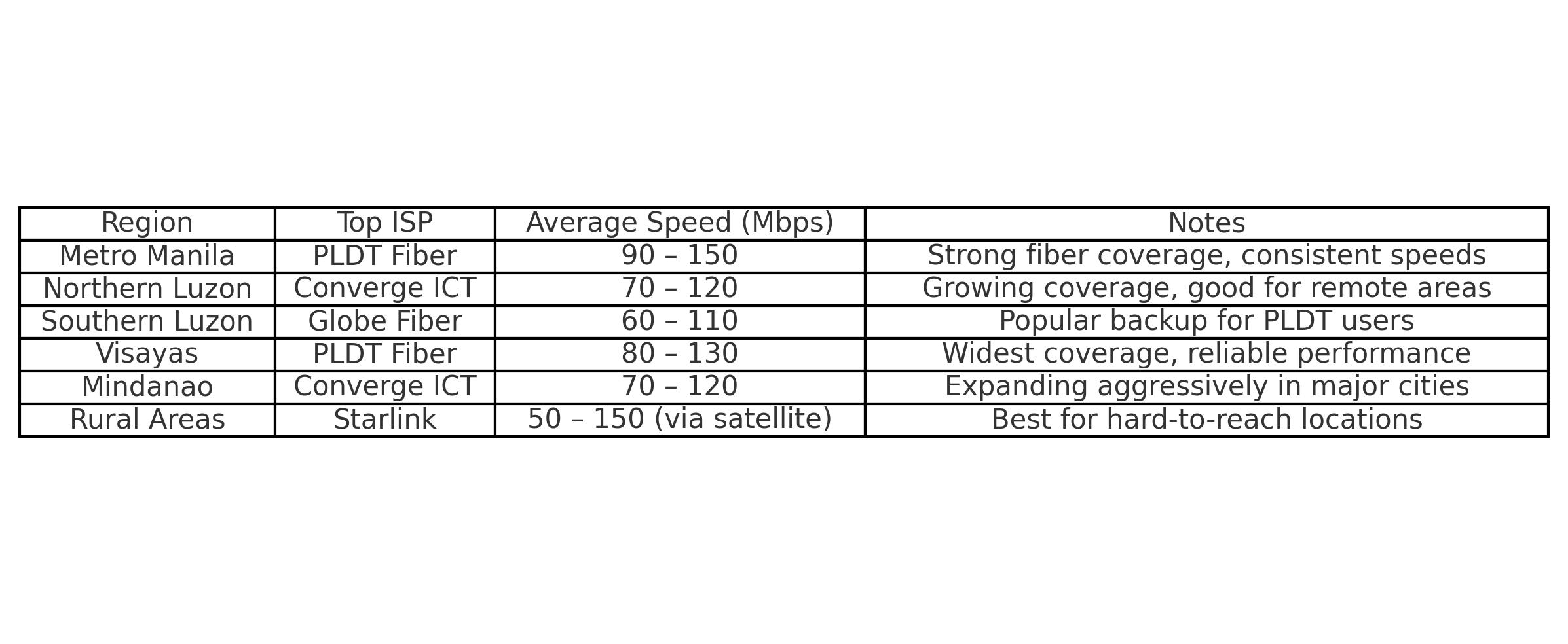
- Metro Manila & CALABARZON: Converge leads for speed and coverage; PLDT and Globe offer steady alternatives.
- Rest of Luzon: Converge expanding rapidly; PLDT remains reliable.
- Visayas: Converge shines in cities; Eastern Communications holds ground in select areas.
- Mindanao: Converge excels, with PLDT and Globe filling gaps where available.
Tips for Choosing the Best ISP for Your Area
Picking an internet provider isn’t just about going for the biggest name out there. It’s about finding what works best where you live. Here are a few tips to make that easier:
1. Check actual coverage, not just ads. Marketing materials can look great, but always confirm if the service is stable in your neighborhood. Ask neighbors or local community groups for feedback—they’re the real experts.
2. Look beyond speed. A high Mbps number sounds impressive, but consistency matters more. A 100 Mbps plan that constantly drops out is worse than a steady 50 Mbps connection.
3. Factor in customer support. Issues will happen. When they do, you want a provider that actually picks up the phone and resolves problems quickly.
4. Consider backup options. If you work from home or have kids doing online classes, having a backup—like prepaid data or another ISP—can save you from stressful outages.
5. Read the fine print. Check for data caps, lock-in periods, and extra fees. Surprises are fun, but not on your bill.
Always prioritize what works best in your area—real-world reliability, responsive support, and transparent terms matter more than flashy speed promises.
Final Thoughts
Finding the right ISP is about keeping your home and work life running smoothly without constant headaches. Converge might seem like the leader here, but the best choice often depends on your location and needs. A few smart decisions now can save you hours of frustration later. How’s your current internet connection holding up? Is it still giving you what you need, or is it time for a switch?
 From My Corner of the Couch