

If you’re like most people, the fresh-start energy of the New Year has long faded, and now you’re standing in the middle of the calendar wondering, “Am I even on track?” Maybe life got busy. Maybe your plans took a different turn. Or maybe—like me—you’re feeling a little anxious about where things are headed. Career-wise, health-wise… it’s a lot to carry.
Truth is, I’ve been sitting with that uneasy feeling too. The kind that makes you question whether you’re falling behind or just finding your way. But even with all the uncertainty, I still believe there’s room for good things ahead. We don’t need to have it all figured out—we just need to take the next honest step forward.
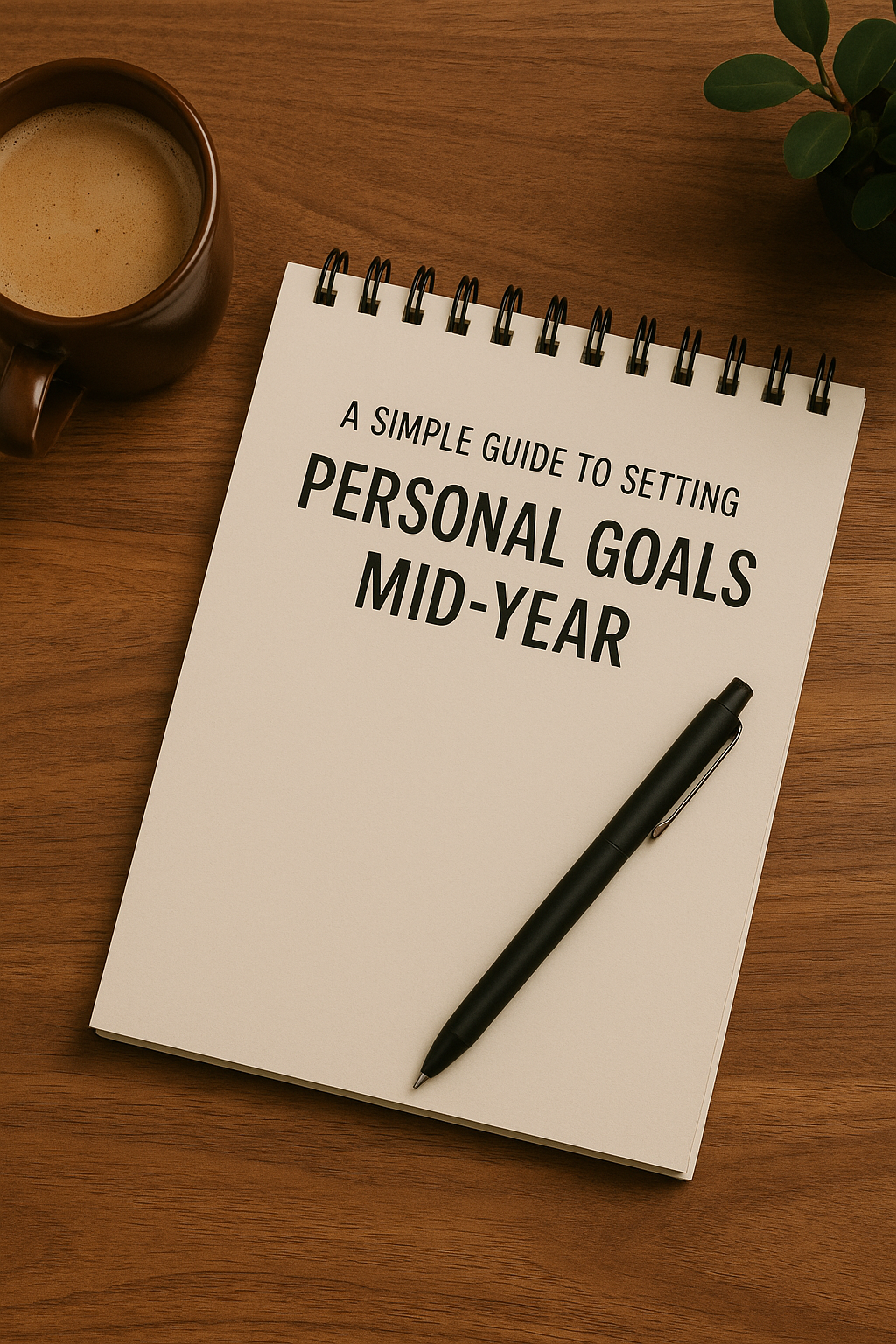
That’s what this guide is about. Not a big overhaul or a strict reset. Just a simple, realistic way to check in, refocus, and set new goals that actually fit where you are now—not where you thought you’d be six months ago.
So if you’re ready for a mid-year pause and a fresh (but pressure-free) restart, you’re in the right place. Let’s walk through this together—one small, doable goal at a time.
💡Why Mid-Year Is the Perfect Time To Reset
January gets all the spotlight when it comes to setting goals. New year, fresh start, fireworks, and all that jazz. But here’s the thing nobody really talks about: mid-year might actually be a better time to pause and reset. Well, not unless you’re the perfect Girl Scout who got all the pins on her crisp uniform. 😹😹
By now, you’ve seen what the year actually looks like. The unexpected detours, the tiny wins, the energy shifts, and the stuff that completely fell off the radar. And speaking of falling off the radar… can I tell you a quick story?
Last November, I was on a mission—fueled by too many caramel machiatttos and an unhealthy level of commitment—to complete the Starbucks holiday rewards promo. You know, the one where you collect enough stickers to claim that fancy planner? I made it. I got the planner. I felt like such a boss. Fast-forward to today: it’s sitting in my room, untouched. Still pristine. Not a single goal scribbled inside. Honestly, it looks like it’s waiting to be sold on Carousel. 😹😹
That little planner, collecting dust, is a perfect symbol of how January goals can feel. Shiny. Full of hope. But not always rooted in reality.
Now that we’re halfway through the year, we actually know more. We’ve felt the pace. We’ve seen what matters and what doesn’t. That makes mid-year the ideal time to reset—not from scratch, but from experience.
You don’t need a big resolution moment. Sometimes, a quiet check-in in July is more powerful than all the glittery New Year declarations combined.
💡Reflect on What’s Worked (and What Hasn’t)
You can’t reset what you haven’t reviewed. That’s the tricky part, isn’t it? Looking back without spiraling into a guilt trip. But reflection doesn’t have to be dramatic. It’s not a report card. It’s more like sitting down with yourself and saying, “Okay, what’s been working—and what’s just been draining me?”
Think back to the goals you set, whether they were written in a planner (ahem) or just floating around in your head. Did any of them stick? Maybe you started walking more. Or said “no” to things that used to drain you. Celebrate that. Seriously, even if it feels small, it counts.
Now, what didn’t work? Be honest but gentle. Maybe that morning routine lasted a week. Maybe you planned to read more but ended up binge-watching documentaries instead. 🖐️🖐️ Same. That doesn’t make you lazy or broken. It just means your rhythm might need adjusting—or that goal wasn’t right for your season.
If it helps, jot down a quick list:
- What gave me energy?
- What felt like a chore?
- What goals feel exciting now?
- Which ones make me roll my eyes?
You don’t need a spreadsheet or color-coded chart. Just a few honest thoughts to guide the reset. The point isn’t to dwell—it’s to understand. Once you know what’s helped and what hasn’t, you’ll have a clearer idea of what to carry forward… and what to let go of with zero guilt.
💡Reconnect With What Truly Matters Now
Here’s the quiet truth we often overlook—what mattered in January might not matter anymore at the moment. And that’s okay.
Life shifts. So do priorities. What once felt important might feel a little out of sync now. And that doesn’t mean you failed—it just means you’ve grown or circumstances have changed. Maybe you were all about career goals back then, but now your health or peace of mind needs to take the front seat. Or maybe you were trying to juggle ten different things, but now simplicity sounds way more appealing.
This is your chance to ask: What do I really want right now? Not what Instagram says you should want. Not what your past self committed to at 11:59 p.m. on New Year’s Eve. But what feels aligned with who you are today?
You don’t need to have some grand answer. Sometimes it’s as simple as wanting to feel more rested. Or wanting your work to feel less like a race. Or finally making time for the thing you’ve been putting off—whether that’s a passion project or just consistent meal prep.
One way to figure this out is to notice what you miss when life gets too busy. What do you daydream about when no one’s asking anything from you? That’s a clue.
It’s okay to trade in goals that don’t fit anymore. The planner police won’t come after you, promise. 🤣🤣 And hey, even if they did, that untouched Starbucks planner could double as your evidence. 🤣🤣
💡Set Fresh Goals That Fit This Season of Life
Now that you’ve looked back and re-centered, it’s time to set new goals—not based on who you were six months ago, but on who you are right now. Because let’s be real: life’s probably handed you a few surprises, and what made sense back then might feel completely off today.
The trick? Keep it simple. Start with one to three things that truly matter to you in this season. Think of them like plants. Don’t try to grow an entire garden if all you can handle right now is watering a snake plant.
Maybe it’s getting stronger, physically or mentally. Maybe it’s finally sorting out your finances or showing up consistently for your family. Or maybe it’s something that doesn’t look “productive” on paper—like resting more or protecting your peace.
To keep things doable, try setting goals using the “make it real” test:
- Is it specific?
“Exercise more” is vague. “Walk 20 minutes after lunch, 3 times a week” is clear. - Is it realistic?
Don’t promise yourself a complete life overhaul if you’re barely holding it together (no shame—we’ve all been there). - Does it excite you—even just a little?
If it feels like punishment, it’s probably not the right goal.
Also, ditch the pressure to be impressive. This isn’t about flashy milestones. It’s about choosing goals that feel meaningful—and manageable—for where you are now.
So, what’s something you’d genuinely feel good about making progress on over the next few months? Write that down. Let that be your starting point.
💡Break Big Goals Into Small, Achievable Steps
Big goals sound exciting—until they start feeling like too much. That’s when overwhelm kicks in, and suddenly you’re staring at the wall wondering where to begin. The secret? Start small. Really small. Like, so small it almost feels silly.
And just to be clear—this isn’t some corporate-style strategy session. No one’s asking you to craft a quarterly roadmap or chase down the next team. This isn’t about hitting a BHAG (you know, those “Big Hairy Audacious Goals” that sound cool until they make you want to cry into your coffee). This is your life. Your pace. Your version of progress.
Let’s say your goal is to get healthier. That’s great, but it’s vague and kind of heavy. So break it down. Maybe it starts with drinking more water. Then, adding a short walk a few times a week. Later, it might mean prepping one balanced meal a day instead of reaching for takeout.
Think of your goal like a staircase. You’re not leaping to the top—you’re taking one step at a time, maybe with snack breaks in between. And if you miss a step? No big deal. You’re still headed in the right direction.
Here are a few ways to make this easier:
- Turn each goal into mini-actions.
For example, “Write a book” becomes “Outline chapter one this week.” - Set weekly or monthly checkpoints.
That way, you’re not relying on willpower—you’ve got structure. - Track progress in a way that feels natural.
Whether it’s a journal, app, whiteboard, or even just checking it off in your notes app, seeing that progress adds momentum.
Breaking goals down also gives you quick wins. And quick wins build confidence. Confidence keeps you going. Before you know it, you’re halfway there, and it feels less like a mountain and more like a path you’re learning to enjoy.
💡Create a System for Staying On Track
Now that your goals are in smaller, doable chunks, it’s time to figure out how to actually keep going. Your system is not there to pressure you, but to gently catch you when you lose momentum (because you probably will… and that’s normal).
Here’s how to do it:
- Pick a check-in rhythm.
Weekly? Every other Friday? Choose a time to sit with your goals and ask, - Keep reminders where you’ll actually see them.
A sticky note on the fridge. A simple lock screen quote. Even a Post-it stuck to your vanity works. - Set alarms without feeling weird about it.
A gentle phone buzz that says “take a breath” or “walk for 5 mins” can be more helpful than you think. - Use tools that fit your brain.
Notion, Google Keep, a paper notebook—whatever helps you track stuff without making it a chore. - Tell someone.
Message a friend. Ask a coworker to check in. Even saying it out loud to your partner counts. A little shared awareness can quietly boost accountability.
This system will gently guide you back when life gets chaotic, which, let’s face it, is probably once a week minimum.
💡Expect Setbacks—But Keep Going
Even the most well-thought-out goals will hit bumps. Life will throw off your routine, energy levels will dip, and some weeks will feel like one giant “meh.” That’s not failure, it’s just part of the process.
I’ll be honest, lately I’ve been feeling a bit discouraged. It’s like I’m trying to keep it together, stay productive, be healthy, all while managing that undercurrent of “Is this even working?” But over time, I’ve learned to motivate myself—because honestly, who else will? Some days, that motivation looks like a full-on pep talk. Other days, it’s just getting out of bed and trying again. Both count.
Setbacks are not the end of your progress. They’re detours. And sometimes, they’re just signs you need to slow down, not stop. If a goal isn’t moving forward, don’t beat yourself up. Instead, ask yourself:
- Is this still important to me?
- Do I need to adjust my approach?
- Am I being kind to myself in the process?
It’s okay to pivot. It’s okay to rest. What matters is that you don’t give up on yourself.
Keep the bigger picture in sight, but let the smaller wins be your guide. There’s no deadline for growth—only a direction. And as long as you’re still moving, you’re not off track. You’re just human.
💡Celebrate Progress, Not Just Results

Here’s something most people forget: progress deserves just as much celebration as hitting the final goal—maybe even more. Because honestly, getting through the messy middle? That’s where the real work happens.
You drank more water this week? 👏👏Nice. You walked three times even though you only planned two? 👏👏👏Still a win. You journaled once, even though the planner’s still mostly empty? 👏👏That counts. Progress is any forward motion, even if it’s slower than you hoped or looks nothing like the original plan.
We’re so used to measuring success by outcomes. But let’s be honest, some of our goals don’t even have neat little finish lines. Growth is often quiet. Sometimes it looks like saying no to something that drains you. Sometimes it’s just choosing not to give up—even when no one else sees the effort.
So celebrate. Light that expensive Bath & Body Works candle you’ve been saving for some imaginary milestone. Take a nap without guilt. Order the fancy drink instead of just thinking about it. Or just look in the mirror and say, “Hey, we’re doing okay.” (Yes, even if your hair’s a mess and you’re wearing yesterday’s shirt.) 🤣🤣
The version of you six months ago might be a little surprised—but definitely proud—that you’re still trying. And that’s more than enough reason to celebrate.
Final Thoughts
You don’t need a perfect plan to move forward. Just a willingness to start where you are. Mid-year isn’t a deadline. It’s a quiet opening—a moment to breathe, reset, and move with intention.
So here’s a question. What’s one small thing you can do today that future-you might quietly smile about?
It doesn’t have to be big. Just honest. Just yours.
Go on. You’ve got this.
 From My Corner of the Couch